Accounts Receivable Outsourcing for CFOs and CPA Firms: What to Delegate or Keep In-House
Heena Jain
Executive Director & SVP, Strategic Accounts
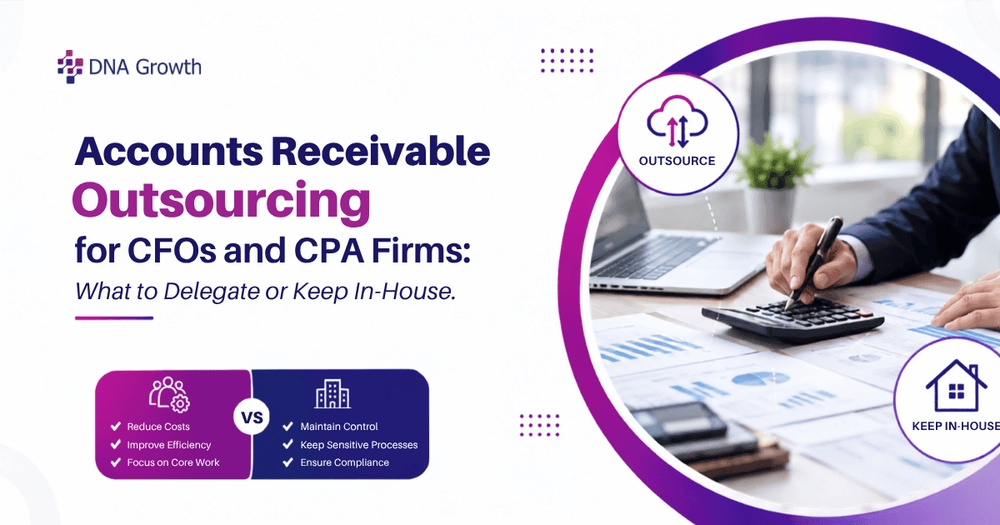
Accounts receivable has an awkward place in most finance teams. Everyone agrees that getting paid matters. CFOs care about cash conversion, controllers care about clean reconciliations, sales cares about customer relationships, and accounting teams care about keeping the aging report under control.
Yet AR is still often managed through a combination of spreadsheets, ERP reports, calendar reminders and whoever happens to know which customers usually pay late. That model becomes increasingly difficult as a business grows.
Invoice volumes increase. Payment methods multiply. Customers dispute charges. Sales teams negotiate exceptions. Finance systems become more complicated. And suddenly a seemingly simple question, “When are we getting paid?” requires someone to piece together information from five different places.
This is where accounts receivable outsourcing is changing.
But outsourcing AR today isn't simply about sending collection work offshore. The more interesting model combines AI-powered workflows, specialized AR professionals and finance oversight to make the entire invoice-to-cash process more predictable.
The AR Problem is Usually Bigger Than Collections
When finance leaders say they have an “AR problem,” they often mean one of three things:
- Customers are paying late.
- The finance team spends too much time chasing invoices.
- Nobody has a reliable view of when outstanding receivables will actually turn into cash.
Those problems are connected, but they don't always have the same cause. A customer may be 45 days overdue because
- Nobody followed up
- Or because the invoice went to the wrong person
- Or because the customer disputes the amount
- Or because the payment was received but wasn't matched correctly
- Or because the contract has a different billing schedule than the accounting system
That distinction matters.
A collections team can chase an invoice faster. It cannot fix a broken invoice-to-cash process by itself.
Current AR management therefore goes beyond sending reminder emails. They also offer extended support for billing, tracking payments, invoice delivery, cash app, aging analysis, prioritizing collections, dispute handling, customer communication, and reporting.
The objective is not simply to have fewer overdue invoices sitting on an aging report. It is to create a more reliable path from
Revenue Booked ? Invoice Issued ? Payment Received ? Cash Reconciled.
That is the part of AR that CFOs should care about.
What Should You Outsource in Accounts Receivable?
Not everything, of course.
A good outsourcing model starts by separating repetitive execution from decisions that genuinely require internal judgment. The transactional layer is usually the easiest place to start. Depending on the business and systems involved, an outsourced AR team can handle:
Billing and Invoicing
- Invoice preparation and generation
- Customer billing schedules
- Invoice delivery and tracking
- Credit memo and adjustment support
- Billing exception identification
Collections
- Aging review
- Prioritization of overdue accounts
- Scheduled payment reminders
- Customer follow-ups
- Escalation tracking
- Promise-to-pay monitoring
Cash Application
- Matching incoming payments to invoices
- Remittance review
- Unapplied cash tracking
- Customer account reconciliation
- Exception identification
AR Reporting
- Aging reports
- Collection status
- DSO monitoring
- Overdue account analysis
- Cash collection forecasts
- Dispute and exception reporting
The internal CFO, controller or engagement leader can then stay focused on the decisions that actually need business context: credit policy, major disputes, customer escalations, write-offs, commercial terms and working-capital strategy.
That division is often more valuable than simply replacing an internal AR employee with an external one.
Where AI Actually Fits Into AR Outsourcing
There is a lot of noise around AI in finance right now. AR is one area where AI can be genuinely useful, provided it is applied to the right tasks.
Current AR automation use cases include payment prediction, collections prioritization, automated outreach, dispute triage and cash application. Industry research increasingly points to these use cases rather than an entirely autonomous finance function.
Consider a 1,000-customer aging report. A traditional process might sort accounts by balance or number of overdue days.
An AI-assisted process can look at additional signals: historical payment behavior, previous disputes, invoice characteristics, customer patterns and payment timing. It can then help determine which accounts deserve attention first.
That changes the question from:
“Which invoices are overdue?”
to:
“Which overdue invoices are most likely to convert to cash, which require intervention, and which represent a genuine risk?”
That is much more useful to a CFO. AI can handle a lot of the repetitive work in AR, but some decisions still need a person. A large customer dispute, an unusual credit, a write-off, or a sensitive customer situation needs context that automation may not have.
The practical model is simple: let AI handle the volume and patterns, while experienced finance professionals deal with exceptions, judgment calls and anything that could materially affect cash or the customer relationship.
The practical model is therefore AI-powered, human-led AR.
Technology handles volume. People handle context. Finance leadership handles judgment.
Why Offshore AR Processing is Becoming More Interesting
Offshore AR processing is sometimes treated as a cost-cutting exercise. That misses a significant part of the opportunity.
For a growing company, the problem may not be that an AR employee is too expensive. The problem is that the business needs consistent coverage across hundreds or thousands of invoices, customers and payment interactions without continuously adding internal headcount.
An offshore team can provide dedicated processing capacity for recurring work while the company keeps ownership of policy, controls and commercial decisions.
For CPA firms, the economics can be even more compelling.
A CPA firm may already manage bookkeeping, month-end close, reporting and tax work for dozens or hundreds of clients. Adding AR management can create another recurring service line, but only if the firm has the delivery capacity to execute it consistently.
This is where AR outsourcing for CPA firms becomes different from simply hiring a low-cost bookkeeping resource.
A white-label AR team can work behind the firm's existing client relationship while handling defined execution workflows. The CPA retains the advisory relationship; the delivery team handles the operational workload.
That can make AR a service the firm can actually scale rather than another task partners promise to “get around to.”
The CFO Test: Don't Measure AR Outsourcing by Headcount Savings
Cost matters. It just shouldn't be the only metric. A cheaper AR function that still leaves the CFO guessing about expected cash collections is not necessarily better.
A stronger scorecard includes:
| Metric | What it tells you |
| DSO | How quickly receivables are converting into cash |
| Current vs overdue AR | Whether the aging profile is improving |
| Collection effectiveness | Whether collection activity is actually producing results |
| Unapplied cash | Whether received cash is being properly matched |
| Dispute aging | Where operational or commercial problems are delaying payment |
| Promise-to-pay performance | Whether customer commitments are turning into actual receipts |
| AR aging by customer | Where concentration and credit risk may exist |
| Forecasted vs. actual collections | How reliable the cash forecast is |
The last metric is particularly important for CFOs. A static aging report tells you what has already happened. A well-managed AR process should increasingly help finance understand what is likely to happen next.
That is where AR begins to connect directly with cash-flow forecasting and FP&A.
When Does it Make Sense to Outsource Accounts Receivable?
There is no universal invoice threshold.
A company with 200 invoices can have a much more difficult AR operation than a company processing 2,000 if its billing structure, customer base or dispute volume is complicated.
The better signals are operational.
Outsource accounts receivable when:
- Finance staff are spending significant time on routine collection follow-ups
- AR aging is reviewed manually in spreadsheets
- Customers frequently claim they never received invoices
- The cash application has a persistent backlog
- The CFO cannot confidently explain major overdue balances
- Collections depend heavily on one or two employees
- The company is growing faster than its finance team
- Sales and finance regularly disagree about customer balances
- A CPA firm wants to offer AR management without adding permanent staff
- A fractional CFO has multiple clients requiring recurring AR execution
- The business needs extended coverage without building another internal shift
There is also a less obvious trigger: the finance team is becoming too senior for the work it is doing.
If a controller spends three hours every Friday chasing routine invoices, the issue is not just productivity. It is an allocation problem. That controller could be reviewing margins, investigating working-capital trends, improving controls or helping management make decisions.
What Should Stay In-house?
This is where poorly designed outsourcing arrangements tend to fail. The external team should not become a black box sitting between the company and its customers.
Internal finance leadership should normally retain control over areas such as:
- Credit policy
- Material credit decisions
- Large customer escalations
- Significant write-offs
- Dispute resolution requiring commercial judgment
- Contractual billing interpretation
- Customer relationship decisions
- Approval thresholds
- Accounting policy
- Final financial reporting responsibility
The outsourced team executes against those rules. That distinction creates accountability without forcing every routine AR task back onto the CFO's desk.
Accounts Receivable Outsourcing vs Hiring Internally
Hiring is not automatically the better option. In-house AR support is relevant when the business needs a resource embedded in customer ops and has enough recurring workload to justify the role.
Outsourcing AR support makes more sense when that workload is dynamic, the business needs expert AR capacity, or finance leadership needs scalability without constantly increasing operational headcount.
A third, increasingly popular option is a hybrid model.
- Internal finance owns policy and exceptions.
- An external team manages execution.
- AI handles prioritization, matching, monitoring and repetitive communication.
For many mid-market businesses and CPA firms, that is a more realistic operating model than either “do everything internally” or “automate everything.”
What to Look for in AR Outsourcing Services
Price per invoice is a poor way to evaluate an AR partner on its own.
Before choosing an accounts receivable outsourcing provider, ask how the provider handles the full workflow.
- Can it work inside the existing ERP?
- Can it reconcile payments?
- How are disputes tracked?
- Who reviews exceptions?
- What happens when an automated collection message is inappropriate?
- How are customer communications documented?
- What controls exist around access to financial data?
- How is performance reported?
And perhaps most importantly:
Can the provider explain why AR is overdue, not just tell you that it is overdue?
A credible AR outsourcing model should give finance leaders visibility into both activity and outcomes. Technology matters, but so does the operating discipline around it.
For CPA firms, AR Can Become a Capacity Multiplier
CPA firms increasingly face a strange combination of demand and delivery pressure.
Clients want more recurring accounting and advisory support, while firms have to be selective about where senior professionals spend their time. Outsourcing has consequently moved beyond emergency staffing and into designing scalable service delivery models. DNA Growth's own CPA-firm model, for example, positions outsourced finance professionals as a white-label extension of the firm's delivery team rather than a separate client-facing vendor.
AR fits naturally into that model.
A CPA firm can retain ownership of the client relationship while an external delivery team handles recurring AR execution under defined processes and controls.
That opens up an interesting possibility: AR management can become part of a broader CAS or outsourced accounting offering rather than a standalone administrative service.
The firm sells the outcome. The delivery infrastructure makes it scalable.
The Future of AR: Less About “Collections” and More About Cash Intelligence
Accounts receivable has traditionally been backwards-looking.
- The aging report tells you what is outstanding.
- The collections log tells you who was contacted.
- The cash report tells you what was received.
AI and better workflow design are pushing AR toward something more useful: a continuously updated view of expected cash, payment risk and intervention priorities.
That matters because AR sits directly between revenue and liquidity.
A business can report strong sales and still struggle because revenue is taking too long to become cash. That is why accounts receivable outsourcing should not be evaluated solely as a bookkeeping or staffing decision. Done properly, it becomes part of the finance operating model.
For CFOs and fractional CFOs, that can mean less time spent supervising repetitive execution and better visibility into working capital.
For CPA firms, it can mean adding recurring AR management without building a large internal delivery team.
For growing businesses, it can mean a finance function that scales without every increase in invoice volume becoming another hiring problem. The technology will continue to improve. The more important question is what happens around it.
The best AR model for most growing finance teams is unlikely to be humans versus AI. AI executes the high-volume work, finance team manages the exceptions, and senior leadership is accountable for decisions affecting cash and customer relationships.
That makes accounts receivable outsourcing a smarter, different approach than moving collections work to just another location.
FAQs: Questions Finance Leaders Ask Before Outsourcing AR
1: Is outsourcing AR just another way of saying collections?
Not really. Collections are one piece of the job.
A proper AR function can cover what happens before and after the collection call too — invoice preparation, delivery, payment tracking, cash application, reconciliation, dispute follow-up and reporting. If invoices are going out incorrectly or payments are sitting unapplied for weeks, simply adding more collection calls won't solve the underlying problem.
2: How much of our AR should we actually outsource?
It depends on where the internal team is losing time.
Some companies outsource almost the entire operational layer and keep credit decisions, escalations and write-offs inside finance. Others start with cash applications or collections and expand once the workflow is stable.
There is no magic percentage. The useful dividing line is usually repeatable execution versus decisions that require company-specific judgment.
3: Will customers know we're using an outsourced AR team?
They don't necessarily have to.
For companies that want a white-label arrangement, the external team can work within the company's existing systems, processes and communication standards. CPA firms can use a similar model when AR work is being delivered as part of a broader client accounting or CAS engagement.
The important part is consistency. Customers should not get a different experience simply because someone behind the scenes is handling the account.
4: Can AI really handle accounts receivable?
It can handle much of the repetitive work. But that does not mean it deserves unrestricted control over the AR function.
AI can help identify collection priorities, predict payment behavior, match payments, flag unusual accounts, summarize disputes and trigger routine follow-ups. Harder cases still need someone who understands the customer, contract, and commercial context.
For most finance teams, the practical model is automation for volume and people for judgment.
5: What happens to disputed invoices?
This is one area where a good AR process separates itself from a basic collections operation.
The goal is not to spam a customer with reminders when they've already told you there's a billing problem. What you need is to capture the dispute, categorize, route it to the right person and follow up until it is resolved.
That also gives finance something useful: visibility into whether recurring disputes are actually symptoms of billing, pricing, contract or operational problems.
6: Is offshore AR processing mainly about lowering costs?
Cost is certainly part of the equation, but it shouldn't be the only part of the business case.
The bigger advantage for many growing companies is capacity. An offshore team can take on recurring AR work without requiring the company to keep adding internal headcount as invoice volume grows.
For a CFO, that can free the internal finance team for forecasting, analysis, controls and decision support. For a CPA firm, it can create additional delivery capacity without putting every new client requirement back on the partners and senior accountants.
7: What should a CFO never hand over completely?
Anything where the decision could materially affect the customer relationship, financial reporting or credit risk deserves clear internal ownership.
That usually includes major write-offs, unusual credit decisions, significant disputes, sensitive customer escalations and changes to credit policy.
An external AR team can prepare the information and execute approved actions. The finance leader should still own the decisions that carry material business consequences.
8: How do I know whether AR outsourcing is actually working?
Don't stop at “the team completed the follow-ups.”
Look at whether the underlying numbers and workflow are improving. DSO, overdue balances, unapplied cash, dispute aging and collection effectiveness are obvious measures. Forecast accuracy is another useful one, particularly for CFOs.
A good outsourced AR function should eventually make it easier to answer a more important question: how much cash is likely to come in, when, and what could prevent it?
9: Can a CPA firm outsource AR for its clients without losing control of the relationship?
Yes, and this is one of the more practical use cases. The CPA practice takes ownership of the client relations, accounting oversight, and advisory support. The outsourced team handles the set AR processes in the backend.
The arrangement works best when responsibilities, approval limits, communication protocols and escalation rules are agreed upon before the first invoice is chased.
10: When does AR outsourcing stop making sense?
If there is very little recurring AR activity, customers are few and highly predictable, and the internal finance team has plenty of capacity, keeping the work in-house may be simpler.
Outsourcing becomes more compelling when the workload is repetitive, growing, difficult to staff, spread across multiple entities or consuming time that higher-value finance professionals should be spending elsewhere.
The decision should be based on the operating model, not simply on whether an external provider can do the work for less.
Executive Director & SVP, Strategic Accounts
Every major account I've managed has reinforced one truth: when clients feel genuinely understood, they grow with you. At DNA Growth, we don't just serve clients — we become their strategic advantage. That's the standard I hold myself and our team to, every single day.
Related Content You Might Like
 White Label Services
Your Clients Are Outgrowing Your White-Label Bookkeeping Setup: How to Build the Full Advisory Stack
White Label ServicesWhite-Label Bookkeeping for CPA Firms and Their Real Estate Clients
White Label ServicesWhite-Label Employer of Record, Payroll and Compliance for CPA Firms
Turn Finance Into a Growth Engine
Join 1,200+ companies that rely on DNA Growth for outsourced CFO, FP&A, and accounting support.