Outsource Accounting in Philippines or India: A Guide for US Businesses
Heena Jain
Executive Director & SVP, Strategic Accounts
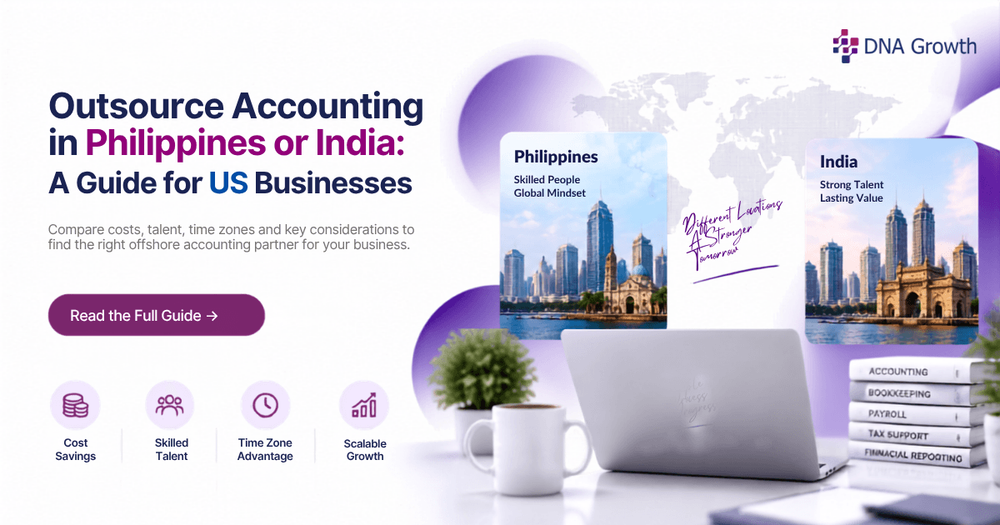
If you are planning to outsource accounting in Philippines, this is where you start your search. This blog takes that question seriously, covers what Philippines-based accounting outsourcing actually offers, and then gives you the honest comparison with India-based outsourcing that most providers in either market will not write for you.
Why Philippines Accounting Outsourcing Became So Popular
The Philippines did not become a US outsourcing destination by accident or by being cheap. English works there the way it works here; it is an official language, not a second one that people switch into for work calls. That distinction matters more than most people account for when they are evaluating offshore communication. There is also a cultural proximity to US business norms that is hard to quantify but shows up in how quickly things get resolved when something is unclear. On the credential side, the CPA-Philippines exam builds US GAAP into the core curriculum, which means Filipino accounting professionals arrive with a foundation that their Indian counterparts sometimes fill in through additional training on the job.
Time zone is the other real advantage: two to three hours of daily overlap with the US West Coast without anyone adjusting their schedule, which matters when a question needs an answer before a deadline. Frontline Accounting, a Philippines-based offshore staffing firm that serves Australian and US accounting practices, was built specifically around these strengths — dedicated staffing, English-first communication, and accounting firm specialization rather than a generic BPO model. That approach works, and the reasons it works are genuine.
The question worth asking is not whether Philippines accounting outsourcing works in principle. It is whether market conditions have changed enough to affect the decision for US businesses building or restructuring their offshore accounting function right now.
What Changed Now: Two Critical Signals Worth Paying Attention To
The AI threat to Philippine BPO is structural, not speculative
The World Bank's World Development Report 2026 named the Philippines among the economies most exposed to generative AI disruption, calling out customer support, transcription, document processing, and data entry as the functions at highest automation risk. Those functions map almost directly onto the entry-level and mid-level accounting processing work that built Philippine BPO volume over the past decade. IBPAP, the industry's own trade association, responded by cutting its 2028 employment forecast from 2.5 million jobs to as few as 1.85 million, citing AI as the primary driver. Revenue is still growing — roughly $40 billion in 2025 — but what is growing is the high-judgment, knowledge-intensive work. The routine high-volume processing layer is being automated, and that transition is already underway.
Frontline Accounting's own blog flagged this in July 2026, noting that conversations about AI are reshaping what offshore accounting work looks like and that the most important question is not whether AI is a threat but how to respond to it.
For US businesses evaluating accounting outsourcing companies in the Philippines, this context matters for one specific reason: if your offshore accounting engagement relies heavily on transaction processing and reconciliation volume without a strong human judgment and review layer on top, you are building on the part of the market most exposed to the AI displacement trend. The Philippines delivery model is adapting, but the adaptation is not complete and the transition creates execution risk during the window.
Botkeeper proved that AI-first accounting is not ready to replace human judgment, YET
In February 2026, Botkeeper closed. The company had taken in close to $90 million in venture funding, built a client base of thousands of accounting firms and small businesses, and spent years marketing itself as the AI-powered replacement for traditional bookkeeping. When it shut down, around 600 people lost their jobs with almost no warning. Hundreds of accounting firms found themselves scrambling for alternative bookkeeping coverage, in some cases just weeks out from tax season with no continuity plan.
The failure was instructive. Reddit discussions in r/Accounting surfaced what many practitioners had suspected: a significant portion of Botkeeper's automation was supported by human labor behind the scenes to catch the AI's errors. The cost structure of running AI systems with humans correcting them at scale proved unsustainable at the margins investors expected. As one industry analysis put it, accounting is not a consumer app. A compliance oversight can trigger penalties. The judgment layer that makes accounting reliable cannot be automated away without consequences.
Bench already demonstrated the vendor-dependency risk in December 2024, when it shut down abruptly and locked thousands of small business owners out of their own financial records. Botkeeper repeated the pattern three months later. The market signal from both failures is the same: AI-first, platform-dependent accounting delivery carries concentration risk that human-led, client-data-owned models do not.
India vs. Philippines: The Honest Comparison for US Accounting Outsourcing
| Criteria | Philippines | India |
|---|---|---|
| Primary credential | CPA-Philippines (PRC). US GAAP in curriculum. 4-part exam. | CA (India) via ICAI. 3-tier exam, roughly 8 to 12% final pass rate. Strongest analytical foundation of any offshore accounting credential. |
| English fluency | Very high across the general workforce. Strong communication alignment with US business norms. | High to very high in the educated and professional workforce. Some accent variation but written communication and technical English are strong. |
| All-in cost (dedicated FTE) | $1,800 to $2,500/month. 50 to 65% below equivalent US hire. | $1,200 to $2,000/month. 60 to 75% below equivalent US hire. |
| Time zone for US | 2 to 3 hours daily overlap with the West Coast. Easier real-time collaboration. | Asynchronous model: work completed overnight India time, ready for US morning review. Works well for structured, cadence-driven workflows. Some offer all time zones. |
| Talent pool depth | Strong for accounting and finance. Smaller market than India. | Deepest offshore accounting talent pool globally. Over 300,000 commerce graduates annually. Mature CPA firm-specific provider ecosystem. |
| AI exposure risk | Higher for routine BPO tasks. Market actively restructuring around higher-value services. | Lower at the knowledge process level. India's KPO sector (including accounting) is categorized as relatively more resilient to automation than contact-center BPO. |
| CPA firm specialization | Growing. Firms like Frontline Accounting built specifically for accounting practices. | Most mature. The largest ecosystem of offshore providers built specifically for US CPA firm workflows, software stacks, and review standards. |
The Philippines wins on English fluency and time zone for West Coast companies where same-day communication matters operationally. India wins on credential depth, cost, talent pool scale, and CPA firm-specific delivery maturity. For most US CPA firms and growth-stage businesses evaluating where to build their offshore accounting function, India is the stronger answer on the criteria that determine whether the engagement produces reliable output over time.
QuickBooks Online and Philippines Accounting Outsourcing
One secondary search term bringing people to this topic is QuickBooks Online Philippines, which reflects a practical question: can Philippines-based accountants work effectively in QuickBooks Online for US clients?
Yes. QuickBooks Online is cloud-based and accessible from anywhere. Philippines-based accountants working with US clients use QBO regularly, and the platform's interface and workflow are the same regardless of geography. The same is true for Xero, and to a lesser extent for desktop-based platforms that require specific software access arrangements.
The more relevant question for any offshore accounting engagement, whether Philippines- or India-based, is not whether the team can access the software but what their workflow inside it looks like. A well-structured offshore accounting engagement uses the client's own QBO subscription with role-based permissions, so the offshore team works inside the client's environment rather than a separate instance. The client owns the data. The offshore team has access appropriate to their function. When the engagement ends, the client's books stay intact in their own account.
Platforms like Botkeeper created the opposite problem: the financial data lived inside Botkeeper's proprietary system. When Botkeeper shut down, firms discovered their client data lived on infrastructure they didn't own and couldn't immediately access. The QBO-native model that most India-based offshore teams operate under avoids that concentration risk by design.
Hybrid Model: What the Human-Led, AI-Augmented Model Delivers
Botkeeper's failure was not an argument against AI in accounting. It was an argument against building an accounting business where AI is doing the work that requires human judgment and humans are quietly cleaning up after it. What is working in 2026 looks different. AI handles the mechanical layer: matching transactions against patterns, flagging things that look off for a human to review, speeding up reconciliations, cutting down on manual data entry.
Humans stay on the parts where a wrong call has consequences — reviewing what goes to the client, making decisions on transactions that do not fit a clean pattern, interpreting what the numbers actually say about the business, and carrying professional accountability when something needs to be signed off.
India-based offshore accounting teams, particularly those with CA-qualified professionals and structured review processes, operate this way by default. Automation doesn't produce the CA credential. Nobody passed the CA (India) exam because an algorithm told them the answer. The exam has a roughly 8 to 12% final pass rate and requires three years of supervised articleship. That background is not something AI augments away. It is the foundation that makes the AI augmentation useful. Put AI in the hands of someone with that training and you get faster throughput on the routine work and sharper judgment on everything else. That is the actual version of human-led, AI-augmented accounting.
It is not a marketing phrase. It is the structural answer to what Botkeeper tried to do in reverse: start with AI and bolt on human oversight when the errors required it, rather than starting with qualified humans and using AI to increase their throughput.
How DNA Growth's Offshore Accounting Model Is Built Differently
DNA Growth is a US fractional CFO support and offshore finance and accounting delivery firm. Our operations are India-based and include accounting experts. We have CA-qualified accountants trained on US GAAP and CPA firm workflows, working inside our clients' own software environments, with US-side CFO-level review on every engagement. All deliverables run under the client firm's brand. The compliance infrastructure, Section 7216 consent documentation for tax data, AICPA ET 1.700 service agreements, and FTC Safeguards Rule vendor protocols, is built into every engagement from the start.
We use AI where it earns its place: matching payments against open invoices, surfacing categorization anomalies before a human reviewer sees them, automating the recurring journal entries that would otherwise consume time on every close cycle. Qualified humans retain the review layer, the interpretation layer, and professional accountability for every deliverable. That is not a positioning choice made in response to Botkeeper's failure. It is the operating model we built because accounting judgment cannot be automated at the quality level US clients and CPA firms require.
For US businesses and CPA firms currently searching for accounting and bookkeeping outsourcing in the Philippines who want to understand why India-based delivery with US oversight is the more reliable answer for their specific situation, the conversation starts at dnagrowth.com.
Executive Director & SVP, Strategic Accounts
Every major account I've managed has reinforced one truth: when clients feel genuinely understood, they grow with you. At DNA Growth, we don't just serve clients — we become their strategic advantage. That's the standard I hold myself and our team to, every single day.
Related Content You Might Like
 White Label Services
White-Label Back-Office Support for Fractional CFOs
White Label ServicesWhite-Label Quality of Earnings and Business Valuation for CPA Firms
Business ConsultingWhite-Label AI for Accounting Firms: Custom Agents That Work
Turn Finance Into a Growth Engine
Join 1,200+ companies that rely on DNA Growth for outsourced CFO, FP&A, and accounting support.