Client Accounting Services and Delivery Capacity
Ishpreet Kaur
Head of Finance & Operations, DNA Growth
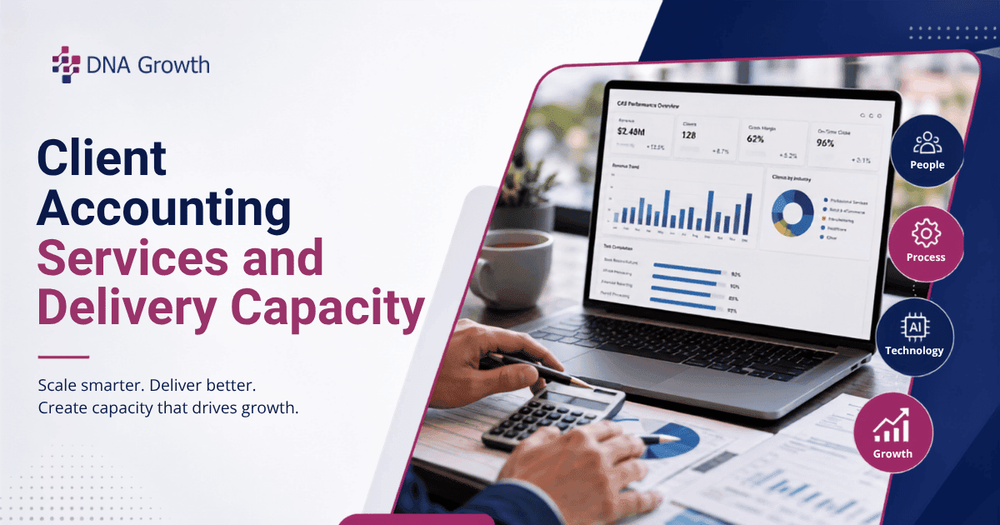
The core argument:
The hardest part of building a CAS practice isn't selling accounting services. It's delivering them profitably, consistently and at scale.
A CPA firm can win another 20 CAS clients and still have a problem if every new client requires another accountant, another reviewer, another set of spreadsheets, and more partner oversight.
That is where the article becomes relevant to both sides of your audience:
- CPA firms that want to grow CAS but don't have enough delivery capacity
- CAS practices that are overloaded
- Fractional CFOs who have sold the strategic layer but need accounting execution underneath
- Firms that already outsource some accounting but aren't happy with quality or consistency
- Accounting firms looking at offshore delivery but worried about client experience
- Firms trying to introduce AI and automation but discovering their processes aren't standardized enough
- Firms that want to increase CAS margins without simply raising prices
I would make the article feel more like an industry operator's perspective than a service page.
A stronger headline could be:
Your CAS Practice Doesn't Have a Sales Problem. It Has a Delivery Problem.
Or, more editorial:
Client Accounting Services Is Growing. But Can Your Delivery Model Keep Up?
Or my favorite:
The CAS Trap: More Clients, More Revenue—and Somehow Less Capacity
That one gives us room to tell a story.
The opening could be something like:
A CPA firm adds 15 new CAS clients.
Revenue goes up. Recurring revenue looks great. The partners are happy.
Three months later, the CAS team is buried, month-end is slipping, senior accountants are doing work below their level, and the partner is back in the weeds reviewing reconciliations.
Nothing went wrong with sales.
Sales worked almost too well.
The problem was the delivery model.
Then we build the article around the uncomfortable reality:
CAS scales commercially much faster than it scales operationally.
That is the hook.
From there, I'd structure it less like a conventional SEO blog and more like a thoughtful industry piece.
1. The CAS growth paradox
Explain how CAS creates attractive recurring revenue, deeper client relationships and advisory opportunities—but every new client also creates recurring operational obligations.
A $2,000/month client isn't simply $2,000 of revenue.
It may mean:
- Monthly close
- Bank and credit-card reconciliations
- AP/AR
- Payroll coordination
- Financial statements
- Management reporting
- Client queries
- Cleanup
- Review
- Corrections
- Year-end support
And those activities repeat every month.
That's the difference between selling a project and building a CAS practice.
2. The hidden capacity tax
This could be one of the strongest sections.
Talk about how senior people gradually become the safety net for everything.
The CAS manager reviews too much.
The partner reviews the manager.
The CFO gets pulled into accounting questions.
The senior accountant cleans up junior work.
Suddenly, the firm has technically “scaled,” but the people who are supposed to be driving advisory growth are spending their time protecting delivery quality.
A simple line could carry the section:
The real cost of an inefficient CAS model isn't just payroll. It's expensive people doing inexpensive work.
That's a very CFO/CPA-friendly observation.
3. Why adding accountants isn't always the answer
This is where we challenge the conventional thinking.
If every 10 new clients require another 2–3 people, you've built a linear business.
And linear isn't necessarily bad. But it limits leverage.
The better question is:
What percentage of the CAS workflow actually requires the person currently doing it?
That naturally introduces process standardization, technology, automation and external capacity without turning the article into a sales pitch.
4. AI won't fix a CAS practice that isn't standardized
This is important for 2026.
There is a temptation to say:
“Let's automate CAS with AI.”
But if every client has a different chart of accounts, close checklist, approval process, reporting format and communication workflow, automation becomes much harder.
AI can accelerate a good process.
It can also accelerate inconsistency.
So before discussing AI accounting, talk about:
Standardize ? automate ? augment ? review.
Not:
Buy AI tool ? hope it works.
This would be a particularly good section for experienced readers because it doesn't treat AI as magic.
5. The delivery stack is changing
This could be the centerpiece.
Show what a modern CAS delivery model can look like:
| Layer | What it should handle |
| Technology | Data capture, workflow, integrations, routine automation |
| AI | Classification, anomaly detection, summaries, research, exception support |
| Accounting team | Bookkeeping, reconciliations, AP/AR, close, reporting preparation |
| Reviewer/Controller | Quality control, complex accounting, exceptions |
| CFO/CPA | Advisory, judgment, client relationship, strategy |
The important point:
Not every layer needs to be inside the same organization.
That's where outsourced/offshore delivery becomes an operating-model discussion rather than a cheap-labor discussion.
6. The offshore question CAS firms are actually asking
Don't make this “Why you should offshore your CAS practice.”
Instead:
“Should we build more delivery capacity internally, or create a hybrid model?”
Then discuss when external capacity makes sense.
For example, recurring accounting execution can often be separated from client-facing advisory and technical review.
The firm keeps:
- Client relationship
- Advisory
- Technical accounting judgment
- Review
- Final accountability
And can use external capacity for appropriately scoped execution.
That distinction is extremely relevant to DNA Growth's ICP without sounding like an advertisement.
7. What a scalable CAS practice actually measures
This would make the article much more useful.
Don't just measure:
Revenue per client.
Measure:
- Revenue per delivery FTE
- Clients per accountant
- Close-cycle time
- Rework rate
- Review hours per client
- Gross margin by CAS client
- Senior-accountant time spent on transactional work
- Client response time
- Percentage of workflows standardized
- Automation rate
- Client concentration
- Churn
Then make a strong observation:
A CAS practice can have excellent revenue growth and still have deteriorating economics.
That's the kind of sentence a partner or CAS leader might actually screenshot.
8. The uncomfortable question: are you selling CAS or selling labor?
This could be the closing section.
If every new client requires proportionately more people, you're essentially selling accounting labor with a recurring billing model.
There's nothing inherently wrong with that.
But if the firm's ambition is to build a scalable, higher-margin CAS practice, it needs leverage.
And leverage doesn't necessarily mean fewer people.
It means more output per unit of senior attention.
That gives us a strong ending:
The future of CAS probably isn't fully automated accounting. And it isn't a giant offshore accounting team either.
It's a delivery model where technology handles what technology is good at, accounting professionals handle what requires accounting expertise, external capacity absorbs work that doesn't need to sit in-house, and the CPA or CFO spends more time on the part the client actually bought from them: judgment.
The firms that figure that out won't just have more CAS clients. They'll have a CAS practice that can actually handle having them.
Head of Finance & Operations, DNA Growth
Ishpreet Kaur (IP) is Head of Finance & Operations at DNA Growth. With 10 years in FP&A at Deloitte and Thomson Reuters, she turns financial planning into a competitive advantage — helping clients gain real visibility and precision in their financial strategy.
Related Content You Might Like
 White Label Services
Your Clients Are Outgrowing Your White-Label Bookkeeping Setup: How to Build the Full Advisory Stack
White Label ServicesWhite-Label Bookkeeping for CPA Firms and Their Real Estate Clients
White Label ServicesWhite-Label Employer of Record, Payroll and Compliance for CPA Firms
Turn Finance Into a Growth Engine
Join 1,200+ companies that rely on DNA Growth for outsourced CFO, FP&A, and accounting support.