Multi-Entity Real Estate Accounting: Consolidating LLCs and SPVs
Ishpreet Kaur
Head of Finance & Operations, DNA Growth
Real estate owners rarely hold property in one company. Each building sits in its own LLC, each development in its own SPV, and a management company and a holding entity sit above them. For the CPA firm doing the books, that means ten sets of financials that owners and lenders want to see as one. This guide walks through how to consolidate multiple real estate LLCs step by step, with an entity map and a worked intercompany example.
Why real estate groups end up with so many entities
The structure usually makes sense on its own terms. Lenders often want each financed property held in a single-purpose entity, so one building's debt can't reach another. Investors in a development deal want their money in a vehicle that holds only that project. Owners want liability kept building by building. And a management company that charges fees across the portfolio is a tidy way to run payroll and overhead.
The accounting cost shows up later. Every entity has its own bank accounts, loan, books and often its own tax return. Money moves between them constantly: management fees, shared expenses paid by one entity for all, loans from the holding company to fund a renovation, equity pushed into a new SPV. Each of those moves is recorded twice, once in each entity, and the two sides have to agree.
When they don't, the owner's combined numbers are wrong in ways nobody notices until a lender asks for a portfolio view or an auditor starts pulling threads. That's the problem multi-entity real estate accounting exists to solve.
How do you consolidate multiple real estate LLCs?
You consolidate multiple real estate LLCs by mapping who owns what, deciding which entities belong in the report, putting every entity on the same chart of accounts, and reconciling intercompany balances. Then both sides agree, eliminate those balances, and combine what's left. In more detail:
- Map the structure. List every entity with its owners and percentages, tax classification, lender, bank accounts and year-end. Draw it. Most of the problems in step 5 trace back to an entity nobody remembered.
- Decide what kind of report you're producing. If one entity, such as a holding company, controls the others, the result is consolidated statements under ASC 810. If the entities are simply owned by the same people with no parent above them, the usual answer is combined statements instead. Partly owned entities and joint ventures need a closer look at control, and private companies under common control may be able to elect out of the variable interest entity rules. Settle this with the engagement partner before anyone builds a workbook.
- Standardize the books. Put every entity on one chart of accounts, with property tracked as a class or location. Align policies too: capitalization thresholds, depreciation lives, how management fees and leasing costs are recorded. Consolidating entities that book the same cost differently produces numbers that add up but don't mean anything.
- Set up intercompany accounts properly. Give each counterparty its own due-to and due-from account, and its own intercompany revenue and expense lines. A single catch-all "intercompany" account can't be reconciled.
- Close each entity and match intercompany both ways. After each entity closes, every due-to must match the corresponding due-from, and every fee charged must match the fee recorded on the other side. Differences get found and fixed now, in the entity books, not hidden in the consolidation.
- Eliminate. Remove intercompany receivables and payables, intercompany revenue and expense, and the parent's investment against each subsidiary's equity. Where outside investors own part of an entity, show their share as a noncontrolling interest.
- Report at both levels. Owners want the portfolio view. Lenders still want each borrowing entity on its own, often with covenant calculations. Build both from the same closed books so they never disagree.
What a typical entity map looks like
Here is a simple but realistic structure: two owners, a holding company, a management company, two property LLCs and a development SPV with an outside investor.
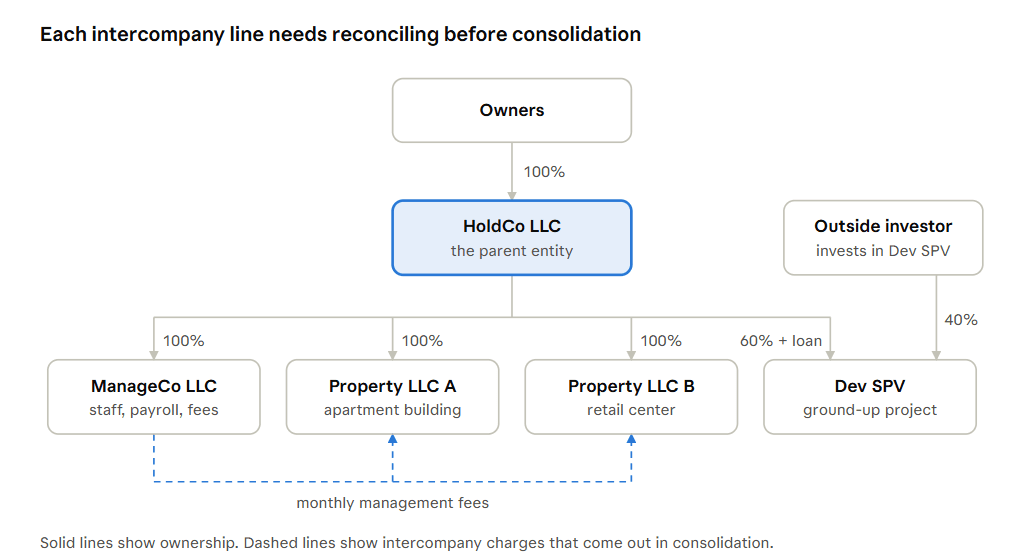
Even this small group creates several intercompany balances every month: management fees from ManageCo to both properties, a loan from HoldCo to the Dev SPV, and HoldCo's investment in each subsidiary. The outside investor's 40% of the SPV must also be shown as a noncontrolling interest. Larger groups have the same pattern, just more of it.
A worked intercompany elimination
Take the group above for one month. These are the intercompany items on the books after each entity closes:
- ManageCo charged Property A $8,000 and Property B $6,000 in management fees. Property A has paid; Property B hasn't yet.
- HoldCo has a $500,000 loan outstanding to the Dev SPV at 6% per year, so $2,500 of interest accrued this month.
- HoldCo invested $1.2 million for its 60% of the Dev SPV. The outside investor put in $800,000 for 40%.
| Item | Shows up in | Matching side | Elimination |
|---|---|---|---|
| Management fees | ManageCo: $14,000 fee revenue | Property A: $8,000 expense; Property B: $6,000 expense | Remove $14,000 of revenue and $14,000 of expense |
| Unpaid fee | ManageCo: $6,000 due from Property B | Property B: $6,000 due to ManageCo | Remove both balances |
| Loan | HoldCo: $500,000 note receivable | Dev SPV: $500,000 note payable | Remove both balances |
| Loan interest | HoldCo: $2,500 interest income | Dev SPV: $2,500 interest, capitalized into the project | Remove the income and take $2,500 back out of the project cost |
| Equity | HoldCo: $1.2M investment in Dev SPV | Dev SPV: $2.0M partners' equity | Remove HoldCo's investment against its share of equity; show the investor's $800,000 as a noncontrolling interest |
Two things in this example catch people out.
Eliminating the fee doesn't change profit. Revenue and expense fall by the same $14,000, so consolidated net income is unchanged. What changes is the picture: the consolidated statements no longer show ManageCo "earning" money from the group's own buildings.
Capitalized interest is easy to miss. Because the SPV is still being built, its loan interest goes into the project's cost rather than to expense. When HoldCo's interest income is eliminated, the matching $2,500 must come out of the project's capitalized cost, not an expense line. Otherwise, the consolidated building is overstated by every month of intercompany interest.
Numbers in the example are illustrative. The pattern is the same at any size.
Where consolidations go wrong, and how to run them monthly
Most consolidation problems in real estate groups aren't technical. They're timing and discipline problems that build up month after month.
One side recorded, the other not. ManageCo bills a fee on the 30th, but Property B's bookkeeper doesn't post it until next month. The two sides disagree; someone books a plug to make the consolidation balance, and the plug quietly grows.
Expenses paid by the wrong entity. The holding company pays the insurance for every building, or a property account covers another property's repair. Unless each payment is recorded as an intercompany charge on both sides, property-level results are wrong even when the consolidated total is right.
Entities closing on different schedules. If the property LLCs close on day 8 and the development SPV on day 20, the consolidation either waits or releases stale numbers.
New entities added informally. A new SPV gets a bank account before it gets a place in the chart of accounts and the entity map. It shows up in the consolidation months later, usually during the audit.
The fix is a fixed monthly routine that treats intercompany as its own step, not an afterthought. Close every entity to the same calendar. Run an intercompany matching report before anything is consolidated, and clear every difference at the entity level. Keep the elimination entries in a standing template so only the amounts change each month. And update the entity map the day a new entity is formed.
That routine is repetitive and detail-heavy, which makes it well suited to outsourced accounting for real estate. A dedicated team can close each entity, match intercompany balances, prepare eliminations, and draft both the consolidated and lender-level reports. The CPA firm keeps the decisions: what gets consolidated, how control and noncontrolling interests are treated, and what the owner and lenders are told. With white-label accounting for real estate, that team works inside the firm's own systems and under its name.
Where DNA Growth fits
DNA Growth works with CPA firms as a white-label accounting team for multi-entity clients. For real estate groups, we close each LLC and SPV on a shared calendar, match intercompany balances, prepare the eliminations and draft consolidated and lender-level reports for your review, all inside your firm's systems and under your name.
If you have a real estate client whose structure has outgrown the spreadsheet, a short pilot on one group is the quickest way to see how the routine holds up. Book a white-label pilot call to scope it.
Head of Finance & Operations, DNA Growth
Ishpreet Kaur (IP) is Head of Finance & Operations at DNA Growth. With 10 years in FP&A at Deloitte and Thomson Reuters, she turns financial planning into a competitive advantage — helping clients gain real visibility and precision in their financial strategy.
Related Content You Might Like
 Accounting and Bookkeeping
Monthly MIS Reporting for Real Estate Companies: A Template
Virtual & Fractional CFOsFractional CFO for Real Estate Investors and Developers: Offshore FP&A
Accounting and BookkeepingWhat a Real Estate CPA Really Does, and How Firms Keep Up
Turn Finance Into a Growth Engine
Join 1,200+ companies that rely on DNA Growth for outsourced CFO, FP&A, and accounting support.