Monthly MIS Reporting for Real Estate Companies: A Template
Ishpreet Kaur
Head of Finance & Operations, DNA Growth
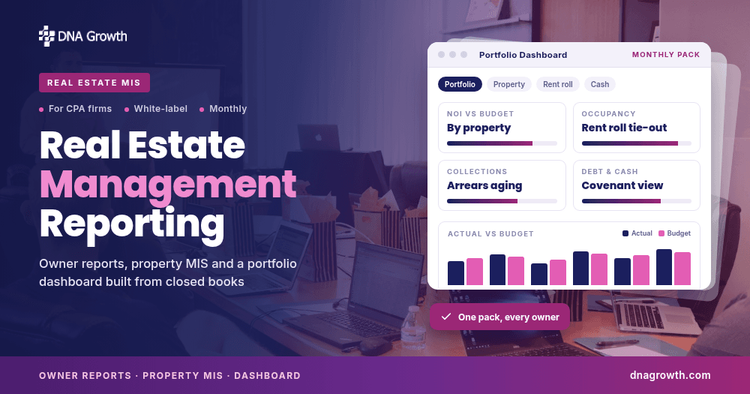
Most real estate owners get plenty of numbers each month. The property manager sends statements, the bank sends balances, and the bookkeeper sends a P&L. What they rarely get is one short pack that shows how the portfolio did, who owes them money, and whether there's enough cash for what's coming. That pack is what good real estate management reporting looks like. This guide sets out what it should contain, page by page, and how to produce it every month without a scramble.
What should a monthly real estate MIS pack include?
A monthly real estate MIS pack should include a one-page summary, a portfolio P&L by property, a rent roll with occupancy and lease expiries, an arrears report, a capex tracker and a cash and debt page. For most owners that's eight to ten pages, which is enough to run the business and short enough to be read.
| Page | What it shows | The question it answers |
|---|---|---|
| Summary | Five or six headline numbers against budget and last month, with three short notes | How did we do, and what needs a decision? |
| Portfolio P&L | Income, operating expenses and NOI by property, with totals, budget and variance | Which properties are earning what we expected? |
| Rent roll | Each unit or tenant, rent, lease start and end, deposits held, vacancy | Who is paying what, and what's coming up for renewal? |
| Arrears | Amounts owed by tenant, aged 0 to 30, 31 to 60, 61 to 90 and over 90 days, with action taken | Who owes us money, and are we doing anything about it? |
| Capex tracker | Each project's budget, spent to date, committed and forecast to complete | Are improvements on budget, and what's left to fund? |
| Cash and debt | Cash by entity, loan balances, rates, maturities and covenant tests | Do we have enough cash, and is any loan at risk? |
| Leasing activity | New leases, renewals, move-outs and vacant units with days vacant | Is occupancy heading up or down? |
| Notes and actions | Decisions needed and items carried from last month | What do we need to do before next month's pack? |
Smaller owners can fold leasing into the rent roll. Developers usually add a project page per site, covering budget, cost to complete and draw status.
What makes each page useful
A list of pages is easy to copy. What separates a pack owners rely on from one they skim is the detail on each page.
The summary page decides whether the rest gets read. Keep it to NOI, occupancy, collections, cash, debt coverage and capex spend, each against budget and last month. Then write three sentences: what went well, what didn't, and what needs a decision. If an owner reads only this page, they should still know where they stand.
The portfolio P&L should be sorted by property, not by account. Owners think in buildings. Show each property as a column with NOI at the bottom, and keep one-off items, such as a large repair or an insurance claim, on their own line so they don't distort the trend. A variance column with a short reason beside any big miss saves a dozen follow-up emails.
The rent roll has to tie to the books. Rent billed on the rent roll should match rental income on the P&L, and deposits held should match the deposit liability on the balance sheet. When they don't, something has been missed, and owners lose trust quickly once they spot it themselves. Flag leases expiring in the next 90 days and any rents below market.
The arrears page needs actions, not just ages. An aged list tells owners how much is late. A column showing the last contact, the agreed plan and the next step tells them whether anyone is handling it. Separate tenant disputes from simple late payers.
The capex tracker shows commitments, not just spend. A project that has spent 40% of its budget but signed contracts for another 55% has very little room left. Show budget, spent, committed and forecast to complete, and how much contingency is left.
The cash page looks forward. Cash today matters less than cash in 90 days. Show balances by entity, then the known outflows coming up: debt service, tax bills, insurance renewals, capex payments and distributions. Add loan maturities and covenant tests so a refinance never comes as a surprise.
The pack and the dashboard do different jobs
Owners often ask for a property portfolio dashboard instead of a pack. In practice, they need both, because each answers a different question.
A dashboard is for checking. It's live or refreshed weekly, and it's where an owner checks today's cash, this month's collections, or which units are empty. It works best with a handful of measures that change often: cash by entity, rent collected against billed, occupancy, arrears over 30 days and capex spend.
The monthly pack is for deciding. It's closed, reconciled and explained. Its numbers won't move after it's sent, and the notes say why things happened and what to do next. Lenders, partners and auditors want this version, not a screenshot of a dashboard.
The two should draw on the same source data and use the same definitions. If occupancy on the dashboard is physical and in the pack it's economic, the owner will notice and stop trusting both. A short definitions page at the back of the pack, showing how each measure is calculated, prevents most of those arguments.
Making the pack run every month
A good real estate MIS pack is rarely hard to design. It's hard to deliver on time, every month, when the inputs come from several places at once: the general ledger, the property management system, bank and loan statements, the capex team and sometimes a spreadsheet only one person understands.
A few rules keep it on schedule.
Fix the calendar. Books closed by day 8 or 10, pack issued by day 12 or 15, review call a few days after. Owners plan around a date that never moves.
Reconcile before you report. Bank, loans, rent roll to income and deposits to the balance sheet should all tie before anything goes into the pack. Most reporting errors are really reconciliation errors that nobody caught.
Build once, refresh monthly. Put the pack in a template that pulls from the trial balance and the rent roll export, so only the data changes each month. Manual retyping is where numbers drift between pages.
Keep a review step. Someone who knows the portfolio should read every pack before it goes out and write the commentary. Software can produce the tables. It can't tell an owner that a vacancy is about to be filled or that a tax reassessment is coming.
Track what was asked. Every question an owner raises on the review call goes on the notes page, with an answer next month. That habit does more for trust than any chart.
Offering the pack under your own name
For CPA firms, a monthly MIS pack is one of the easiest ways to move a real estate client from bookkeeping to advisory. The client already pays for clean books. A pack built on those books, with a monthly call to walk through it, is a natural next tier, and it's the work that keeps clients from shopping around.
The catch is the hours. Reconciling rent rolls, chasing capex numbers and refreshing the same pages for twenty clients every month is steady, detailed work that rarely fits around tax deadlines. That's why many firms use white-label accounting for real estate: a team prepares the pack in the firm's template and branding, while the firm's staff review it, write the commentary, and run the client call.
For real estate owners who don't work with a CPA firm, the same model applies directly. Outsourced accounting for real estate can cover the books, reconciliations, and the pack, leaving the owner's team to make the decisions it points to.
Where DNA Growth fits
DNA Growth prepares monthly management reporting packs and dashboards for real estate clients, either white-labeled for CPA firms or directly for owners. Our team closes and reconciles the books, ties the rent roll, updates the capex tracker and cash forecast, and builds the pack in your format for review.
To see the structure in practice, download our Real Estate MIS template. It includes every page described above, ready to adapt to your clients' portfolios.
Head of Finance & Operations, DNA Growth
Ishpreet Kaur (IP) is Head of Finance & Operations at DNA Growth. With 10 years in FP&A at Deloitte and Thomson Reuters, she turns financial planning into a competitive advantage — helping clients gain real visibility and precision in their financial strategy.
Related Content You Might Like
 Accounting and Bookkeeping
Multi-Entity Real Estate Accounting: Consolidating LLCs and SPVs
Virtual & Fractional CFOsFractional CFO for Real Estate Investors and Developers: Offshore FP&A
Accounting and BookkeepingWhat a Real Estate CPA Really Does, and How Firms Keep Up
Turn Finance Into a Growth Engine
Join 1,200+ companies that rely on DNA Growth for outsourced CFO, FP&A, and accounting support.