Offshore Tax-Season Staff for CPA Firms: Hire by January (2027 Guide)
Ishpreet Kaur
Head of Finance & Operations, DNA Growth
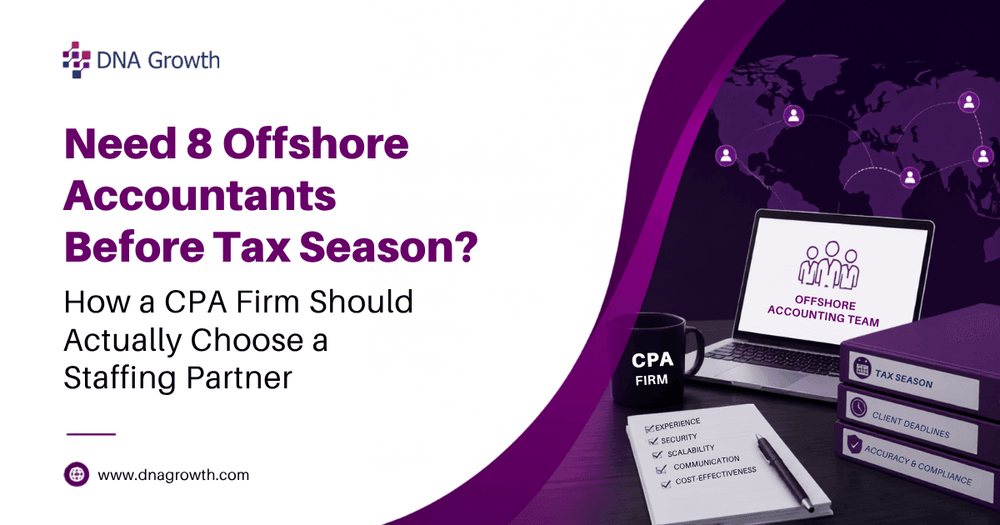
If your CPA firm needs 8 offshore accountants before the next tax season, you probably do not have a simple hiring question anymore. You have a capacity problem with a deadline attached to it.
That changes how you should evaluate offshore staffing companies.
Quick answer: offshore tax-season staff for the 2027 season
- When to start: Scope the work and shortlist providers in December 2026, run a pilot on representative files, and ramp the team through January 2027 so it is productive before the March 15, 2027 deadline for calendar-year partnership and S corporation returns.
- What they prepare: Mid-level offshore accountants (3 to 7 years post-qualification) typically prepare 1040, 1065 and 1120-S returns under senior review. See what each experience tier can handle.
- Who reviews and signs: Your US CPAs keep client ownership, final review and signing. Offshore staff draft the returns and workpapers, and Section 7216 consent comes first.
- What it costs: The 2026 benchmarks in our offshore accountant hiring guide put an India-based accountant at that level at $1,400 to $1,900 a month per FTE. Judge any quote on fully loaded cost, as explained below.
The cheapest provider is not necessarily the best option. Neither is the company with the largest offshore headcount, the longest list of certifications, or the most polished sales presentation. What matters is whether the people you receive can work inside a CPA firm's delivery model without creating another layer of work for partners and managers.
- Can they work with U.S. tax and accounting workflows?
- Have they supported CPA firms before?
- Can they work in your tax software and accounting stack?
- Who reviews their work?
- What happens when an assigned accountant leaves?
- How is sensitive client information protected while work is performed offshore?
Those are the questions that matter.
Why is the Number Less Important Than the Work Behind it?
'We need 8 accountants' sounds precise. Operationally, it tells a staffing partner very little.
Eight junior bookkeepers are not equivalent to eight professionals who can prepare partnership returns, perform tax workpapers, handle complex reconciliations, support audit schedules, or work independently inside a U.S. CPA firm's review process. The right mix depends on what is creating the bottleneck.
A tax-season crunch may require tax preparers, bookkeeping cleanup capacity, and experienced reviewers. A CAS-heavy practice may need accountants who can own month-end close, reporting and client workflows. An audit practice may need staff who understand PBC schedules, lead sheets and workpaper discipline.
So start with a workload map, not a headcount.
Staff Augmentation or Managed Outsourcing?
With staff augmentation, the firm generally wants dedicated people operating under its workflows, technology, managers and standards. This is often a strong fit when a CPA firm already has good processes but lacks capacity.
A managed outsourcing model transfers more delivery infrastructure, supervision, staffing continuity, and sometimes quality control to the provider. That can work when the firm wants to transfer a defined process rather than manage additional people.
There is also seasonal or project-based capacity. This can help when demand is concentrated around filing deadlines, but the firm should account for training and review time.
For a firm hiring eight people, I would ask: do we want eight people, or do we want eight people's worth of dependable output? Those are not always the same thing.
What 'CPA Client Experience' Should Mean?
A provider saying it has 'accounting experience' is not enough.
CPA firms operate differently from corporate accounting departments. Deadlines are client-driven. Work moves through preparer, senior, and reviewer layers. Documentation matters. Tax and accounting systems vary. Workpapers must be understandable to someone who did not prepare them.
This is why prior CPA-firm experience should be tested at the workflow level. Ask what work the professionals have actually performed, which U.S. tax applications they know, how they handle review notes, how they document missing information, and when they escalate technical questions.
Public provider materials illustrate how specialized this market has become. Global Staffing Solutions says it is CPA-owned and provides training in QuickBooks, Lacerte, UltraTax, IRS protocols, and U.S. tax. BusAcTa describes dedicated offshore support for U.S. CPA and EA firms with CPA-supervised review. Acculink markets dedicated CPAs, EAs, and Chartered Accountants for accounting, tax and audit work. These are provider claims and should be independently validated during procurement.
Which offshore staffing companies should a CPA firm contact?
There is no defensible universal ranking because providers differ by geography, staffing model, specialization, security environment, pricing and degree of U.S. management.
A sensible shortlist should include providers that can demonstrate actual CPA-firm experience and then be narrowed through your own due diligence.
Examples with public CPA/accounting-firm positioning include Global Staffing Solutions, BusAcTa, Acculink CPA, Vance & Cole and ProVise Partners. Their models are not identical: some emphasize CPA ownership and U.S.-tax training; others emphasize dedicated teams, managed facilities, review layers or U.S.-focused professionals.
DNA Growth belongs in the same evaluation conversation for firms looking for dedicated offshore accounting capacity, white-label execution and broader finance delivery. The right question is not whether one provider is 'best.' It is whether its operating model fits your firm's workload, review structure, client base, technology stack and risk requirements.
The questions I would ask every provider
- How many U.S. CPA or accounting firms do you currently support, and what work do they send offshore?
- Can we interview the actual professionals who would be assigned to us?
- What happens when an accountant leaves or underperforms during busy season?
- Who performs technical review, and how is review responsibility divided?
- Which U.S. tax and accounting applications can the proposed team work in?
- What happens when a preparer encounters an ambiguous tax position, missing documentation or unusual accounting treatment?
- How do you measure quality? Ask for review-note rates, rework, turnaround and error tracking rather than general assurances.
- Where and how is client data accessed, processed and stored?
- What is included in the fee: recruitment, training, management, backup staffing, software, replacements and QA?
- Can we run a controlled pilot using representative work?
If a provider is uncomfortable with these questions, that is useful information.
Security is not a footnote
Once client tax returns, financial statements, payroll records or identity information move outside the firm's immediate environment, information security becomes part of the outsourcing decision.
Ask where work is performed, whether staff work from controlled facilities, how role-based access and MFA are enforced, whether local downloads are restricted, how activities are logged, how access is revoked, and what the incident-response process looks like.
For U.S. tax practices, firms should also understand their own obligations concerning taxpayer information and arrangements under which tax return information is disclosed or used. A provider's certification does not transfer the CPA firm's professional and legal responsibilities.
Public claims vary. Acculink states that it is ISO 27001:2013 and GDPR certified and lists SOC 2 Type II among its credentials. Vance & Cole describes a biometric-secured facility and IRS-WISP-compliant environment. Such claims should be verified through current documentation, contractual terms and independent assurance reports where appropriate.
The economics: don't compare an offshore rate with a U.S. salary
The useful comparison is the fully loaded cost of capacity.
Effective offshore cost = provider fee + internal management time + training + review/rework + technology + transition costs + replacement risk.
Publicly advertised pricing varies. Acculink currently advertises rates starting at $8–$35 per hour; LedgerBridge publishes monthly packages beginning at $2,000 for a dedicated accountant; J. Gordon BPO advertises dedicated staff from $1,600 per month. These are provider-published examples, not standardized market rates, and included services differ materially.
For a CPA firm, the better question is: how many reviewable units of work do we receive for every dollar of delivery cost? If a low-cost resource requires heavy partner intervention, the apparent saving can disappear.
The hidden cost most firms miss: review capacity
This is where offshore staffing decisions often succeed or fail.
Suppose eight offshore accountants are producing work, but three U.S.-based seniors spend a large portion of every day correcting workpapers, explaining basic processes and chasing missing information. The firm has added eight people but not eight productive units of capacity.
Track first-pass acceptance, review-note density, turnaround time, rework hours, escalation frequency and percentage of work completed by deadline.
The objective is not zero review. CPA work should be reviewed appropriately. The objective is to make the review layer efficient enough that senior U.S. professionals spend their time on judgment, client relationships and final quality control.
How I would onboard eight people before tax season
I would not move eight seats into production on day one.
Start with a controlled pilot using representative work: a straightforward engagement, a messy client, a deadline-sensitive file and a more complex example. Measure output.
If the pilot works, expand gradually. A practical ramp might be two professionals first, four next, then the full team once quality and communication are stable. The exact timetable depends on the firm.
Give the provider a clear operating manual covering naming conventions, workpaper standards, escalation rules, review notes, client-specific exceptions, software procedures and turnaround expectations.
Offshore staffing works much better when the provider receives a process to execute rather than a vague instruction to 'help with accounting.'
The 2027 tax-season hiring calendar
Working back from the 2027 filing deadlines, this is the order that leaves room for a pilot and a staged ramp:
| When | What to do |
| December 2026 | Map the workload by return type (1040, 1065, 1120-S), shortlist three to five providers, send the same security questionnaire to each and interview the people who would be assigned to you. Add Section 7216 consent language to engagement letters and organizers. |
| Late December 2026 to early January 2027 | Run the controlled pilot on representative files: a straightforward return, a messy client and a deadline-sensitive file. Measure first-pass quality and review time. |
| January 2027 | Grant software access, hand over the operating manual and ramp in stages, for example two people, then four, then the full team. |
| Late January 2027 | The IRS opens the 2027 e-filing season (the IRS announces the exact date each year), and individual return volume starts to build. |
| Monday, March 15, 2027 | Calendar-year Form 1065 and Form 1120-S returns are due, or extended with Form 7004. |
| Thursday, April 15, 2027 | Form 1040 and calendar-year Form 1120 returns are due, or extended with Form 4868 or Form 7004. |
| September 15 and October 15, 2027 | Extended partnership and S corporation returns, then extended individual and C corporation returns, are due. Keep part of the team on through the extension season. |
Firms that start looking in February are choosing a provider while the first deadline is already in view. Starting in December turns the pilot into a real test rather than a gamble.
What should stay with the U.S. team?
Offshore does not mean every activity should move offshore.
Depending on professional responsibilities, engagement terms, technical risk and client expectations, routine preparation, reconciliations, workpaper assembly, data gathering and defined accounting processes may be appropriate for offshore execution. Client ownership, final review, signing responsibilities, sensitive judgment calls and higher-risk advisory decisions often remain with U.S. professionals.
The right question is not 'What can we send offshore?' It is 'Where does this work create the highest value when performed by each layer of the organization?'
What the current CPA conversation tells us
Recent discussions among U.S.-focused accounting professionals describe offshore support for tax preparation, bookkeeping and audit work as increasingly common. The recurring concerns are quality control, communication, training and data security rather than the basic concept of offshore work.
That makes operational design the real differentiator. Technology is rarely the difficult part. The difficult part is creating a repeatable delivery system in which the offshore team knows what 'done' means, the U.S. team knows when to intervene, and both sides share the same definition of quality.
If I were a CPA firm hiring eight offshore accountants today
I would shortlist three to five providers rather than twenty.
I would give each the same workload profile and security questionnaire. I would interview the actual proposed team. I would ask for evidence of CPA-firm experience rather than accepting a generic logo list. I would run a controlled pilot using representative work. I would measure turnaround time, first-pass quality, review burden, communication and escalation behavior.
And I would make the final decision based on total operating economics, not the lowest monthly quote.
Most importantly, I would build the team before the deadline becomes urgent. If the first production week is the week before a major filing deadline, you are not testing an outsourcing partner. You are gambling on one.
A final perspective for CPA firm owners and managing partners
The real value of offshore accounting staffing is not simply that an accountant in another country costs less than one in the United States.
The value is that a well-designed global delivery model can give a CPA firm access to additional capacity without forcing every increase in workload into the U.S. hiring market.
That matters when hiring is slow, busy season is concentrated, margins are under pressure, or partners want senior people focused on advisory work.
But the model works only when quality, security, accountability and workflow ownership are designed into it.
If your firm needs eight people, start by defining the eight outcomes. Then find the provider capable of producing them consistently. That is a much better procurement strategy than simply searching for the cheapest offshore accounting company.
Quick provider comparison framework
| Provider | Public positioning | What to validate |
| Global Staffing Solutions | CPA-owned; U.S.-tax/accounting training | References, team credentials, security |
| BusAcTa | Dedicated support for U.S. CPA/EA firms | Review model, software coverage, team experience |
| Acculink CPA | Dedicated CPAs/EAs/CAs; accounting, tax and audit | Certification scope, references, data controls |
| Vance & Cole | Dedicated managed teams; secured facility | Security evidence, supervision, continuity |
| ProVise Partners | Dedicated U.S.-focused professionals for CPA firms | Scale, credentials, reviewer structure |
Frequently asked questions
When should a CPA firm hire offshore staff for the 2027 tax season?
Start in December 2026. That leaves time to scope the work, run a pilot on representative files and ramp the team through January, so the offshore staff are productive before the March 15, 2027 deadline for calendar-year partnership and S corporation returns.
How many offshore accountants should a CPA firm hire?
There is no universal ratio. Start with workload and required output, then determine the experience mix and review capacity.
Is offshore accounting suitable for CPA firms?
It can be, particularly for defined production and support work, when technical review, confidentiality, workflow controls and responsibility boundaries are designed properly.
Should a CPA firm hire offshore accountants directly or use a staffing company?
Direct hiring can provide control but requires recruitment, employment administration, infrastructure and continuity planning. A specialist partner can absorb more of that operating burden.
What should I look for in an offshore accounting staffing company?
CPA-firm experience, U.S. tax/accounting skills, access to proposed staff, credible review, security controls, software compatibility, continuity planning and transparent commercial terms.
Can offshore accountants work with U.S. tax software?
Many specialist providers advertise experience with platforms such as Lacerte, UltraTax, ProConnect and Drake. Test the actual professionals proposed rather than relying only on a general capability statement.
How can a CPA firm protect client data when outsourcing offshore?
Use contractual controls, role-based access, MFA, secure transfer, endpoint controls, logging, confidentiality requirements, access revocation, incident response and appropriate vendor due diligence.
Is offshore staffing only useful during tax season?
No. Teams can support bookkeeping, month-end close, CAS, tax preparation, audit support and recurring finance work throughout the year.
Head of Finance & Operations, DNA Growth
Ishpreet Kaur (IP) is Head of Finance & Operations at DNA Growth. With 10 years in FP&A at Deloitte and Thomson Reuters, she turns financial planning into a competitive advantage — helping clients gain real visibility and precision in their financial strategy.
Related Content You Might Like
 Accounting and Bookkeeping
Monthly MIS Reporting for Real Estate Companies: A Template
Accounting and BookkeepingMulti-Entity Real Estate Accounting: Consolidating LLCs and SPVs
Virtual & Fractional CFOsFractional CFO for Real Estate Investors and Developers: Offshore FP&A
Turn Finance Into a Growth Engine
Join 1,200+ companies that rely on DNA Growth for outsourced CFO, FP&A, and accounting support.