

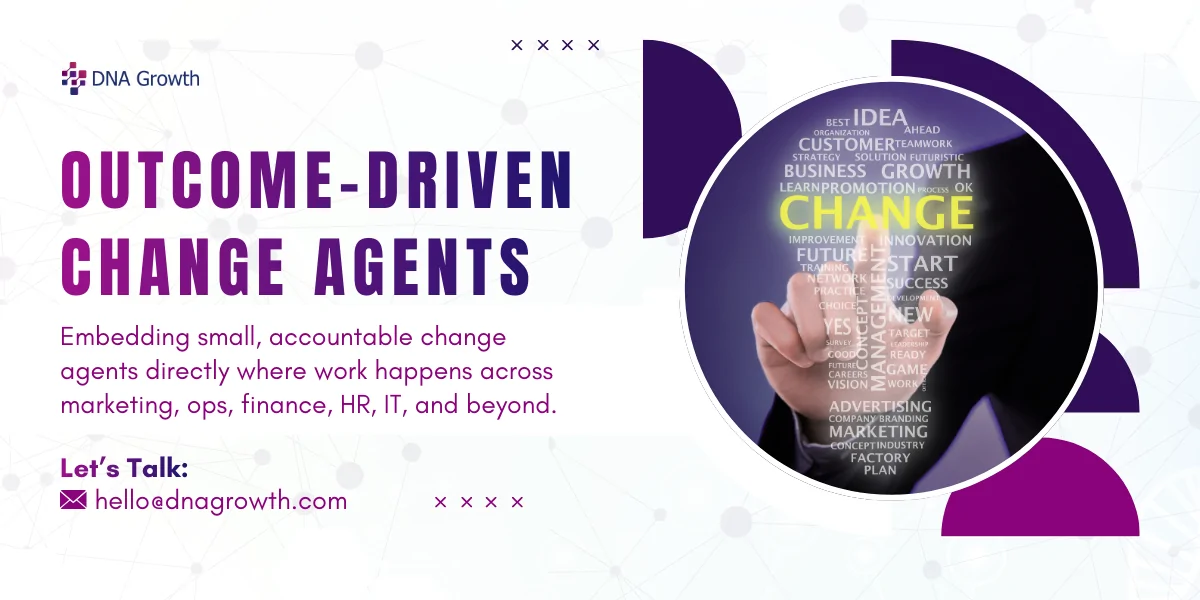
This white paper on outcome-driven change agents explores the growing movement towards decentralizing change ownership through embedded transformation roles within every business function. It presents the business case for distributing change leadership across micro-roles, empowering frontline employees, and ensuring continuous adaptability without disrupting operational continuity. It also examines[...]
Read More
Most startup founders don’t struggle because they lack ambition or intelligence. They struggle because the way they plan their business doesn’t align with how capital providers evaluate risk. Approximately 50% of new small businesses survive the 5-year mark. A startup business plan is often treated as[…]
Read More
Most founders don’t lose funding conversations because the idea is bad. They lose them in the first 3–7 minutes when the investor or lender starts pulling on one thread, and the whole plan unravels: “Walk me through how you actually acquire customers.” “What breaks if pricing is 10%[…]
Read More
Operational support functions are strategic enablers of organizational agility, navigating complexity, and driving enterprise-wide transformation. This white paper introduces a modernized Return on Investment (ROI) framework for operational support, shifting the focus to impact indicators such as change velocity, workforce productivity, complexity absorption, and risk mitigation, revealing the[...]
Read More
In boardrooms across the US and MENA, a quiet shift is underway. Founders, dealmakers, and seasoned operators are rethinking a long-held assumption: that serious financial leadership must always come from a full-time, in-house CFO. For many growth-stage companies, the answer today is an outsourced CFO, not as a[…]
Read More
This white paper on redesigning ops for fluid change examines the essential transition from static operators to iterative orchestrators, leaders who unify people, process, and technology to propel continuous transformation. It presents actionable strategies to rearchitect operations for speed and scalability, embed adaptability at every level, and harness[...]
Read More
Global Capacity 2.0 represents a fundamental shift in how enterprises execute at scale. Where traditional delivery relied on centralized labor hubs, standardization, and cost, this model introduces borderless, digitally enabled execution frameworks that empower organizations to deliver consistent, innovation-driven outcomes across geographies.
Read More
The conversation around fractional CFO costs has shifted dramatically over the last 24 months. US and MENA founders, portfolio operators, and CFOs aren’t just asking “How much will it cost?”—they’re asking “What does this investment unlock at this stage of my business?” As companies scale faster, raise selectively,[…]
Read More
As fast as the SaaS space is evolving, growth is intoxicating, but only if it’s backed by a financial model that scales with integrity, discipline, and transparency. Without a rigorous audit process to validate metrics, controls, and compliance, early growth can quickly become a structural risk. A well-executed[…]
Read More
This white paper introduces Transformation Load Balancing as a strategic approach to aligning change efforts with an organization’s actual capacity. By integrating adaptive planning, modular delivery, cultural alignment, and load-aware governance, organizations can avoid burnout, reduce initiative failure, and sustain momentum. The shift from static programs to responsive[...]
Read More