

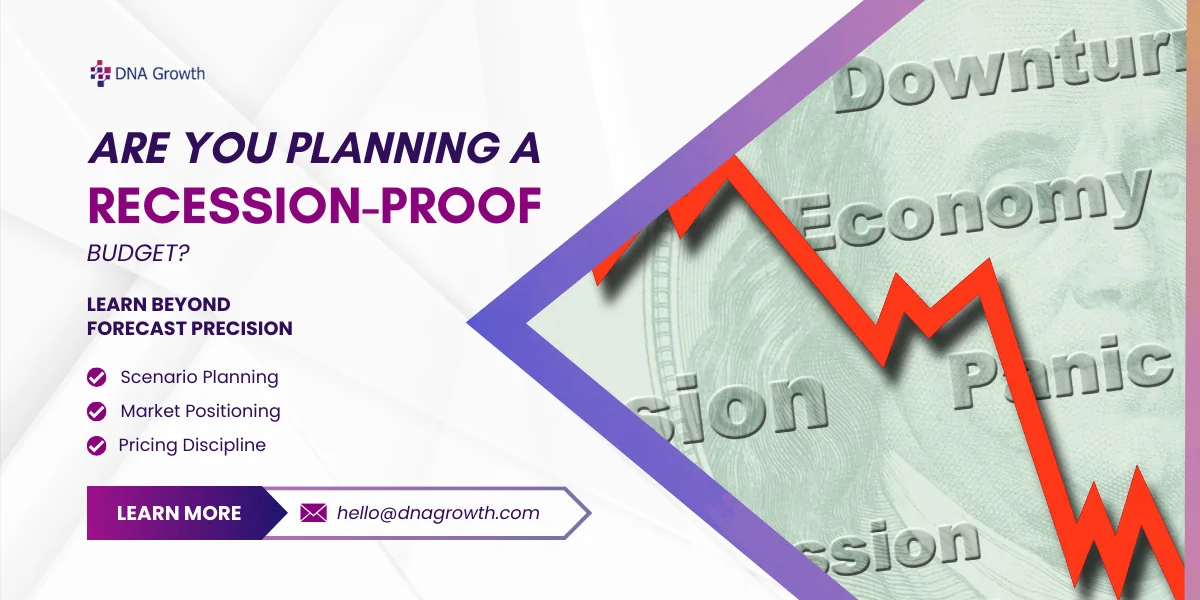
Budgeting for a Recession in Volatile Markets: How CFOs Protect Liquidity Without Freezing Growth
Budgeting for a recession is rarely about numbers alone. In volatile markets, it becomes a test of judgment, sequencing, and leadership.
When uncertainty rises, most organizations default to familiar responses: cut costs, pause hiring, defer investment, and preserve cash at all costs. While these actions may feel prudent, experienced CFOs know that blunt cost-cutting often creates long-term damage that outweighs short-term relief.
The real challenge in budgeting for a recession is not deciding whether to protect liquidity. It is deciding how to do so without undermining the very capabilities that allow the business to compete, adapt, and recover.
This is where executive-level recession budgeting diverges sharply from tactical expense management.
But Why Do Traditional Budgets Fail During Recessions?
Most annual budgets are built for stability, not volatility. They assume relatively pfredictable revenue, steady operating costs, and linear growth or decline. Recessions break those assumptions quickly.
Revenue volatility increases, sales cycles elongate, customer payment behavior changes, and cost structures become less predictable. A static budget becomes obsolete within days or even weeks.
CFOs who rely on traditional annual budgets during downturns often experience two failure modes. The first is a delayed reaction—by the time the variance is visible, cash has already leaked. The second is overreaction—cuts are made too aggressively, impairing revenue generation, operational resilience, or customer trust.
Effective budgeting in a recession requires abandoning the idea that a single budget will remain valid. Instead, finance leaders shift toward dynamic, decision-driven planning.
Liquidity Is the Constraint, Not Profitability
In recessions, businesses rarely fail because they are unprofitable on paper. They fail because they run out of cash.
This distinction is critical. Budgeting for a recession starts with a clear understanding that liquidity—not margin—is the binding constraint. CFOs who recognize this early reframe the entire budgeting conversation.
Rather than asking how to “cut expenses by X percent,” they ask more precise questions:
How long can current cash sustain operations under different revenue scenarios?
Which costs are structurally fixed versus operationally flexible?
Which investments directly protect cash velocity or revenue durability?
This mindset shifts recession budgeting from cost reduction to cash orchestration.
The CFO Trade-Off: Liquidity Preservation vs. Strategic Capability
One of the most difficult aspects of budgeting for a recession is distinguishing between discretionary and strategic costs.
Not all expenses contribute equally to resilience. Some costs—such as redundant tools, underutilized vendors, or non-core initiatives—can be reduced with minimal downside. Others—such as customer success, core technology, finance infrastructure, or key revenue roles—directly influence survival and recovery.
Senior CFOs approach this trade-off deliberately. They evaluate expenses based on their relationship to three questions:
- Does this cost help us collect cash faster?
- Does it protect existing revenue?
- Does it preserve optionality for recovery?
Expenses that fail all three tests are candidates for reduction. Those that support one or more are examined more carefully, even if they appear “non-essential” at first glance.
This is why recession budgeting at the executive level is less about blanket cuts and more about prioritization under constraint.
Budgeting for a Recession Requires Scenario Thinking, Not Forecast Precision Alone
In volatile markets, precision is often an illusion. CFOs who attempt to fine-tune a single forecast during a recession usually spend more time revising assumptions than making decisions.
Instead, effective budgeting for a recession relies on scenario planning, not in the abstract, but in operationally meaningful ranges.
Finance leaders typically model a small number of scenarios—often three—that represent realistic operating states: a base case, a downside case, and a severe stress case. The purpose is not to predict which scenario will occur, but to understand how the business behaves under each.
This approach allows CFOs to answer critical questions before pressure mounts:
- At what point does cash become constrained?
- Which costs must be addressed first in each scenario?
- What decisions are reversible, and which are not?
When these questions are answered in advance, leadership avoids reactive decision-making when conditions worsen.
Growth Does Not Stop During Recessions. It Just Changes Form
A common misconception is that budgeting for a recession means choosing between survival and growth. In reality, growth rarely disappears; it changes shape.
During downturns, volume-driven expansion often slows, but opportunities emerge in efficiency, retention, pricing discipline, and market repositioning. CFOs who freeze all growth investment risk emerging weaker relative to competitors who reallocate capital more intelligently.
Strategic recession budgeting does not eliminate growth spend. It refocuses it.
Investments that improve cash flow visibility, reduce operating friction, strengthen customer relationships, or enable faster decision-making often deliver outsized returns during downturns. These are the investments that allow organizations to exit recessions with momentum rather than inertia.
Understanding The Role of Rolling Forecasts in Recession Budget Planning
One of the most effective tools CFOs use when budgeting for a recession is the rolling forecast. Unlike static budgets, rolling forecasts evolve continuously and incorporate the latest operating data.
This allows finance teams to detect changes in customer behavior, cost dynamics, and cash flow early. It also creates a feedback loop between operations and finance, enabling faster course correction.
Rolling forecasts do not eliminate uncertainty, but they shorten the distance between reality and response. In recessions, that distance often determines whether decisions are proactive or forced.
Why Does Cash Flow Governance Matter More Than Cost Control?
During recessions, organizations often focus intensely on reducing expenses while overlooking cash governance. This is a mistake.
Cash flow discipline extends beyond expense management. It includes invoicing cadence, collections rigor, vendor payment terms, capital expenditure controls, and working capital optimization.
CFOs who succeed in budgeting for a recession treat cash flow as an operational process rather than just a financial outcome. They ensure visibility into near-term cash movements and establish clear accountability for cash-impacting decisions across the organization.
This governance creates stability even when revenue fluctuates.
Budgeting for a Recession is Also a Communication Exercise
Budgets do not exist in isolation. They shape behavior.
When leadership communicates recession budgets poorly, teams either panic or disengage. When communicated well, budgets become a framework for aligned decision-making.
Senior CFOs invest time in explaining not just what decisions are being made, but why. They clarify which constraints are temporary, which priorities are non-negotiable, and how teams should evaluate trade-offs.
This clarity reduces friction, preserves morale, and prevents the hidden costs of confusion during already stressful periods.
What Changes After the Recession Ends?
One of the overlooked benefits of disciplined recession budgeting is what remains after conditions improve.
Organizations that budget effectively during downturns often emerge with stronger financial hygiene, better cash forecasting, clearer cost structures, and more resilient operating models. These improvements persist long after the recession fades.
CFOs who view budgeting for a recession as a defensive exercise miss this opportunity. Those who treat it as a forcing function for better finance leadership build a lasting advantage.
Budgeting for a Recession in a Nutshell
Budgeting for a recession is not about predicting how bad things will get. It is about ensuring the organization retains control amid increasing volatility.
CFOs who succeed in volatile markets do not rely on rigid budgets or reflexive cuts. They focus on liquidity, scenario readiness, and disciplined prioritization. They protect the core while preserving the ability to adapt.
In the end, recession budgeting is less about austerity and more about intent. The businesses that survive and often outperform are those whose finance leaders understand that protecting liquidity and enabling growth are not opposing goals but interconnected responsibilities.