

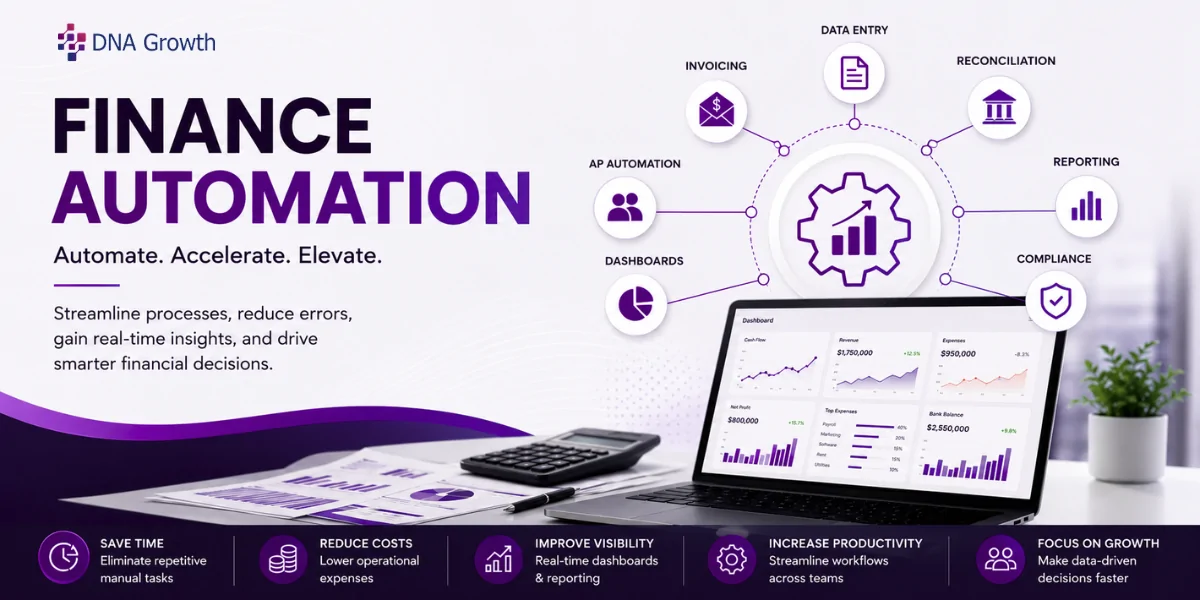
Financial Automation: The Strategic Shift in Modern Finance Teams
Financial automation is no longer a future-state initiative reserved for enterprise finance departments.
It has become a core operational requirement for modern CFOs, fractional CFOs, controllers, CPA firms, and finance leaders trying to manage increasing complexity without continuously expanding headcount.
The finance function is under pressure from every direction:
- Faster reporting cycles
- Growing compliance expectations
- Higher demand for real-time visibility
- Increased transaction volume
- Multi-entity operations
- Rising labor costs
- Talent shortages across accounting and finance
At the same time, leadership teams expect finance to deliver more strategic insights rather than spending valuable time on repetitive administrative work.
That is exactly where financial automation is creating a measurable impact.
Organizations that invest in financial accounting automation are reducing manual processes, improving reporting accuracy, accelerating close cycles, and creating finance teams that can operate with significantly higher efficiency. The shift is especially visible among mid-market companies, outsourced accounting providers, CPA firms, and growth-stage businesses that need scalable finance infrastructure without building oversized back-office teams.
What is Financial Automation?
Financial automation refers to the use of software, AI-enabled systems, workflow tools, and integrated finance technology to automate repetitive accounting and financial management tasks.
Instead of relying on spreadsheets, manual reconciliations, disconnected systems, and email-driven approvals, finance teams use automation to streamline processes across:
- Accounts payable
- Accounts receivable
- Expense management
- Bank reconciliations
- Revenue recognition
- Payroll workflows
- Budgeting and forecasting
- Financial reporting
- Cash flow tracking
- Audit preparation
- Compliance documentation
One of the most valuable applications is the ability to automate financial statements and reporting workflows.
Rather than manually consolidating data from multiple systems at month-end, automated finance platforms can pull, validate, organize, and generate reports in real time.
This dramatically reduces reporting delays while improving consistency and accuracy.
Why CFOs Are Prioritizing Financial Accounting Automation
For years, finance transformation initiatives focused heavily on ERP implementation and process standardization.
Today, the conversation has evolved.
CFOs are now focused on operational scalability.
The question is no longer: “Can automation reduce manual work?”
The real question is: “How quickly can finance become more intelligent, responsive, and scalable?”
This shift matters because finance teams are expected to support increasingly strategic decisions:
- Capital allocation
- Pricing strategy
- Scenario planning
- Cash preservation
- M&A readiness
- Investor reporting
- Operational forecasting
Manual processes slow down every one of these functions.
When controllers and accountants spend days reconciling spreadsheets or correcting reporting inconsistencies, finance loses valuable analytical capacity.
Financial automation helps reclaim that capacity.
Modern CFOs are using automation not simply to cut costs, but to create finance environments that deliver:
- Faster decision-making
- Improved forecasting accuracy
- Better internal controls
- Higher reporting confidence
- More scalable operations
- Stronger audit readiness
- Reduced process dependency on individual employees
This is particularly important for fractional CFOs, interim CFOs, and on-demand finance leaders managing multiple clients or business units simultaneously.
Automation standardizes engagements while improving visibility and operational consistency.
Key Areas Where Financial Automation Creates the Most Value
1. Financial Reporting Automation
Manual reporting remains one of the largest operational bottlenecks inside finance departments.
Teams often spend significant time exporting data, cleaning spreadsheets, reconciling balances, formatting reports, and validating numbers before leadership reviews can even begin.
By implementing systems that automate financial statements, organizations can:
- Shorten month-end close cycles
- Improve reporting consistency
- Reduce spreadsheet dependency
- Eliminate repetitive data entry
- Create real-time dashboards
- Improve stakeholder visibility
Automated reporting workflows also reduce the risk of version control issues and human error that commonly affect spreadsheet-based environments.
2. Accounts Payable Automation
AP automation remains one of the highest ROI initiatives in finance transformation.
Modern systems can automatically:
- Capture invoice data
- Match purchase orders
- Route approvals
- Detect duplicate invoices
- Schedule payments
- Maintain audit trails
This significantly reduces manual processing time while strengthening financial controls.
For CPA firms and outsourced accounting providers, AP automation also improves client responsiveness and operational scalability.
3. Bank Reconciliation and Close Management
Reconciliation work is often repetitive, time-intensive, and highly dependent on manual review.
Financial accounting automation tools now use AI-assisted matching and transaction categorization to accelerate reconciliations and reduce exceptions.
Many finance teams are cutting close timelines from weeks to days through automated reconciliation workflows.
This creates faster access to reliable financial data for leadership teams.
4. Forecasting and Cash Flow Visibility
Finance leaders increasingly need real-time visibility into liquidity, revenue trends, and operational performance.
Automation enables finance teams to integrate live operational data into forecasting models instead of relying solely on static monthly reports.
This improves:
- Cash flow management
- Working capital visibility
- Forecast responsiveness
- Scenario analysis
- Strategic planning accuracy
For growing companies, this level of visibility can materially improve financial decision-making.
The Role of AI in Financial Automation
Financial automation is evolving beyond workflow digitization.
AI-powered finance systems are now capable of:
- Detecting anomalies
- Identifying duplicate transactions
- Predicting cash flow patterns
- Flagging unusual spending behavior
- Automating data categorization
- Supporting variance analysis
- Assisting with financial forecasting
While human oversight remains essential, AI is significantly improving operational efficiency inside finance functions.
The most effective finance organizations are not replacing finance professionals.
They enable finance professionals to spend less time on repetitive administrative work and more time on analysis, advisory work, and strategic planning.
This distinction matters.
The future of finance is not fully autonomous accounting.
It is augmented finance operations where automation handles repetitive execution while finance leaders focus on judgment, strategy, and business partnership.
Common Challenges in Financial Automation Implementation
Despite the advantages, many automation initiatives fail to deliver expected ROI because organizations underestimate operational complexity.
The most common implementation mistakes include:
- Automating broken processes
- Poor system integration planning
- Lack of standardized workflows
- Incomplete data governance
- Insufficient user training
- Overreliance on spreadsheets after implementation
Successful automation projects typically begin with process evaluation.
Before implementing technology, finance leaders should identify:
- High-volume repetitive tasks
- Manual approval bottlenecks
- Reporting delays
- Data inconsistencies
- Control weaknesses
- Cross-functional workflow dependencies
The goal is not simply to digitize finance.
The goal is to create scalable financial operations that improve visibility, control, and decision-making.
How CPA Firms and Fractional CFOs Benefit from Financial Automation
For CPA firms, outsourced accounting providers, and fractional CFO practices, financial automation is becoming a competitive differentiator.
Clients increasingly expect:
- Faster reporting
- Real-time financial visibility
- Technology-enabled advisory services
- Scalable support models
- Better forecasting insights
Automation helps firms serve more clients efficiently without compromising service quality.
It also enables finance professionals to shift toward higher-value advisory work instead of spending excessive time on transactional processing.
This transition is reshaping the accounting industry.
The firms creating long-term value are not competing solely on bookkeeping efficiency.
They are building technology-enabled finance ecosystems that combine automation, strategic insight, operational visibility, and scalable advisory support.
Final Thoughts
Financial automation is no longer a tactical upgrade. It is becoming foundational infrastructure for modern finance operations.
As reporting demands increase and finance teams face growing pressure to deliver faster insights with leaner resources, automation is helping organizations create more agile, scalable, and intelligent finance functions. Whether the goal is to automate financial statements, improve reconciliation workflows, accelerate close cycles, or enhance forecasting accuracy, financial accounting automation is now central to how high-performing finance teams operate. For CFOs, controllers, CPA firms, and outsourced finance providers, the opportunity is no longer simply about reducing manual work.
It is about building finance operations that support growth, strategic decision-making, and long-term operational resilience in an increasingly data-driven business environment.